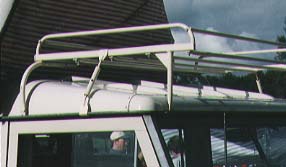
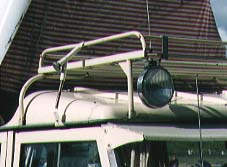
The two racks shown on the left are the original
Dormobile racks. They only differ in the accessories added
AND by the clamps that hold them to the vehicle. Roof racks
were standard fitment on Dormobiles ordered directly through
North American Land Rover dealers. They were an extra
cost option if the Dormobile was ordered directly from Martin
Walter.
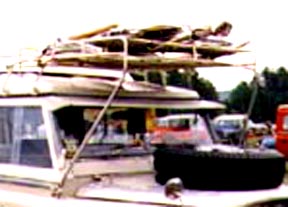
Brownchurch made a larger light duty roof rack. This rack
was also made out of light duty thin wall tubing. It stuck
out over the windscreen with front attachments to the bottom
of the windscreen. This provided around twice the roof storage
space and kept stress off the windscreen. But the thin wall
tubing flexes easily and there was minimal diagonal bracing.
It was not unusual for the front legs of the rack to bend to
the side when the car was at a side angle and was jarred. This
destroyed the legs and warped the rack. The Brownchurch
rack was built to come apart into a package small enough to
be shipped by common carrier.
The Brownchurch roof rack was a popular after market rack. It
was made from 3/4 inch dia. thin wall steel tubing and was
lightweight. The
top disassembled into a size that could be shipped.
The rack
was much larger than the optional Dormobile rack and it
had front braces anchored at the base of the windscreen to
keep weight stresses from breaking the windscreen off road.
But there were no braces in the rack to protect from lateral
torsion. Heavily weighted racks tended to bend their legs off
roading on a sideways on a hill. Few of these racks survived
undamaged.
It is my understanding that the last Brownchurch Dormobile
roof rack was built around the early 70's and that they have
since lost their original build drawings.
Brownchurch roof rack
L. R. Bits in the UK makes a selection of roof racks specifically for Dormobiles.
In 1998 I designed a Dormobile roof rack based upon
the overall dimensions of the Brownchurch roof rack but much
stronger and with diagonal bracing to stand up to torsional forces. The
Rack was briefly put into production by British Pacific before
their roof rack fabrication company ceased business.
The inside rail load space is slightly over 40 inches by 57 inches.
It is made from 3/4 inch rectangular galvanized steel tubing, so
tie down straps can be attached anywhere .
The rack as six mounting points. Two at the rear, two at the middle
and two on the front at the base of the windscreen. Properly mounted,
the weight rests primarily on the front and rear legs with the
center to take up extra weight and torsional forces. The rear and
center legs are diagonally braced in two directions for torsional
strength.
Since any roof rack adds wind resistance it was important to me
that it be easily removable. The rear and middle legs are attached
with gutter clamps (No holes in the body). The front mount features
a quick release. The mount base stays attached to your windscreen's
bottom bolts. You just pull a pin from the base of each leg to
separate the front legs from the car. This eliminates half the
work to mounting and unmounting the rack.
Front Gerry Can Mounts
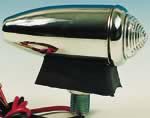
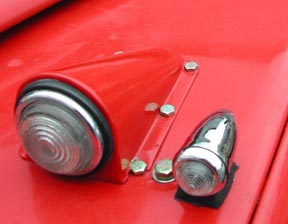
Lucas LS516 parking lamp
2 top lens mounting systems were used. One is shown
on the right using a stock turn signal lamp in a single lamp
housing and a Lucas # LS516 front
parking lamp.
Land Rover optional front bumper mounted gerry
can holders were occasionally ordered as part of a Land Rover
Dormobile conversion. Illustrated
is the early style for Land Rovers that have their headlamps
mounted on the radiator bulkhead. The turn signals and parking
lamp holes in the wing are covered with sheet metal and the
lamps are mounted to the top of the wing. Since
these are Land Rover optional parts they are not diagnostic
for identifying a Dormobile.
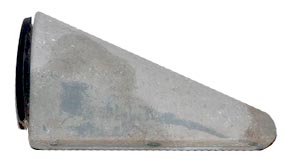
Wing top Turn signal housing
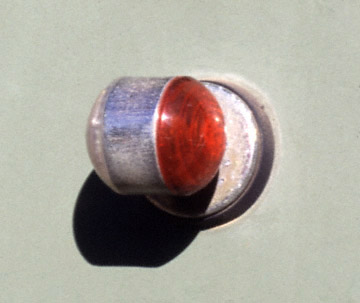
Night parking warning lamp
This photo shows a L.E.P. night parking lamp. It is mounted
on the driver's side behind the front door about 2 inches below
the front external roof latch and is used as a warning lamp for
relevant traffic when camped alongside a road during the night. The
clear lens faces forward, the red towards the rear. It is
illuminated by a single low wattage lamp. I believe this
was an option to meet a UK regulation in effect sometime
during the 1960's and '70's.
Insect Screens
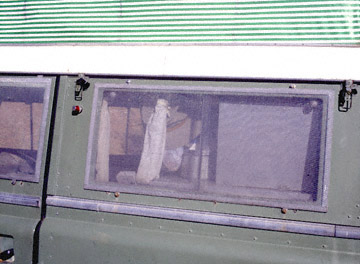
Martin Walter offered an option of insect screens
for the rear side door and the rear side window for 109 station
wagons. In addition there was an optional insect screen
for the roof vent.
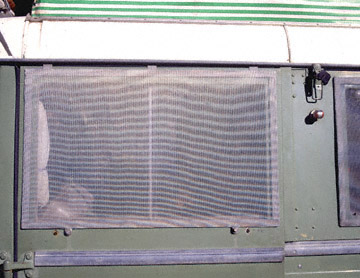
Optional insect screen over rear side door
The side window screens were made from rectangular steel bars
welded together then galvanized. The metal insect screen
runs over the top and folds under the screen. It is held
in place by being pressed between the body and frame. The screen
frame for the rear side window is held in place by four bolts attached
to rivnuts added to the sides of the top. The screen frame
for the rear side doors have top hooks that hang the frame from
the door and a pair of bolts through rivnuts to hold the screen
bottom in place.
Optional insect screen for rear side window
Problem areas with the optional screens are that air flowing past
them at highway speeds tends to make noise and their weight can
sometimes cause the rivnuts to come loose. This is especially
true for Dormobiles that drive through high brush that strikes
the flat edges of the frames.
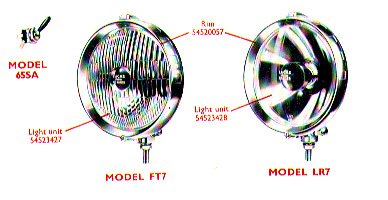
Auxiliary Lighting
Below is a scan from a Lucas parts book, dated 1967. It shows
the Road lamp and fog lamp that are listed in the Martin
Walter options list. Road Lamp, Lucas 6LR Ranger and Fog lamp,
Lucas 6 FT Ranger. Unfortunately, the Lucas lamps with the number
6 in the description are called Pathfinder, and the lamps that
are called Ranger have the number 7 in the description. Go figure.